Paper Garden Ginkgo Against a Dark Wall in a Glass Garden Room
A golden leaf does not have to disappear among the real leaves outside a garden room. Paper Garden 04 uses broad fan shapes and dark lines that read differently from the changing detail beyond glass. Against a solid charcoal wall, its pale ground becomes a clear object in the room, while the ochre leaves introduce warmth. The print has something distinct to contribute even when greenery is already part of the view. It is a graphic arrangement, not an attempt to provide an extra artificial window.
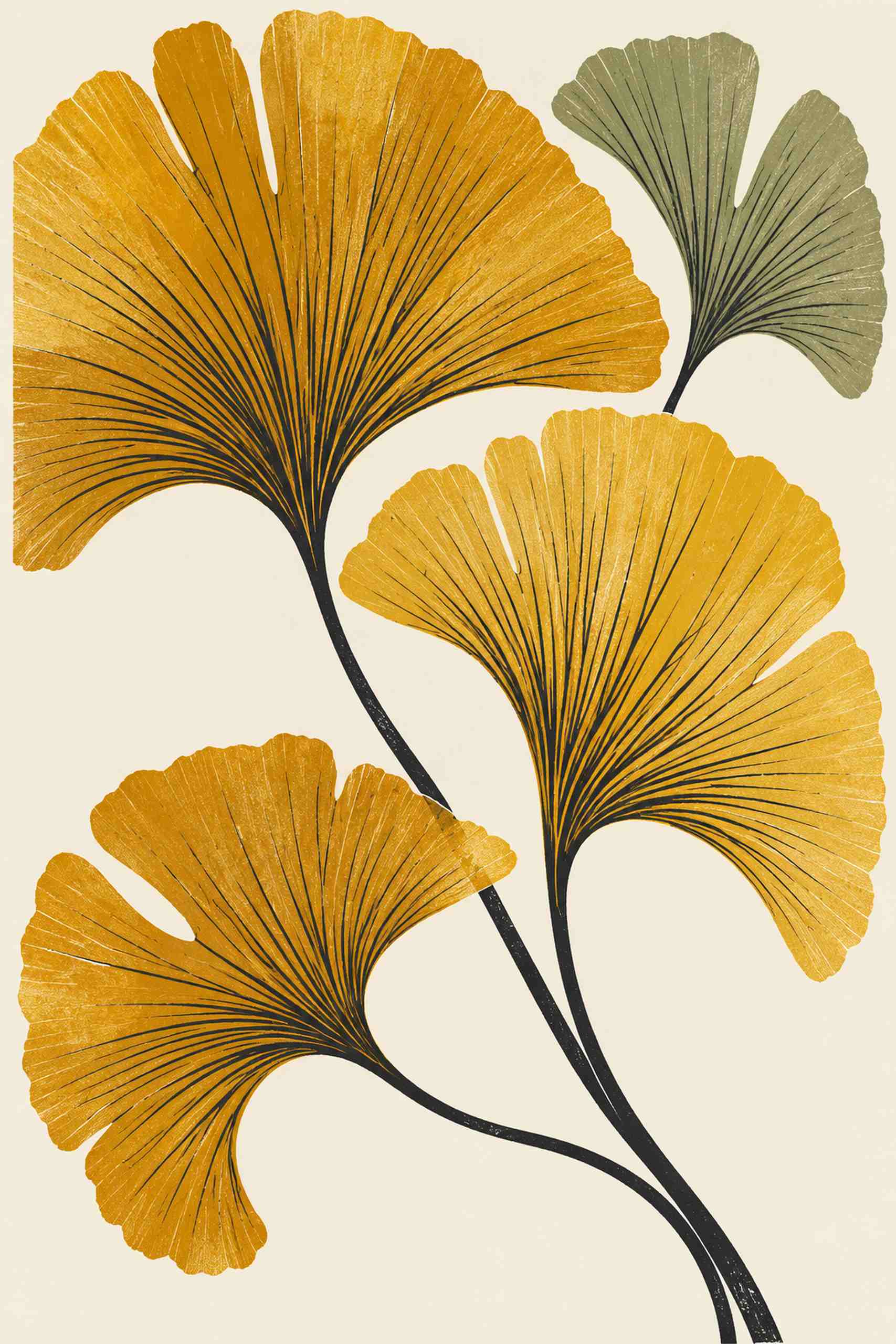
The work is unchanged from the small breakfast corner. Its golden ginkgo-like fans, one quieter olive leaf and sinuous dark stems retain the same spacing and printed-looking marks. In that earlier setting, the image sat among lighter furniture and a pale wall. Here, the dark surface gives its ivory field a stronger perimeter. Keeping the numbered artwork identical makes the comparison useful: the altered presence comes from its neighbors, rather than from a newly generated set of leaves that happens to have the same name.
Our room concept is fully enclosed, with black-framed glass, a solid back wall, a stone-like floor and green modern chairs on thin legs. A small dark table keeps the seating practical. The frame hangs on the solid wall rather than being placed against a window, so the picture can have its own boundary and a surface behind it. The materials are more architectural than rustic. There is no need for wicker, floral upholstery or a collection of small botanical prints to announce that this is a room connected with a garden.
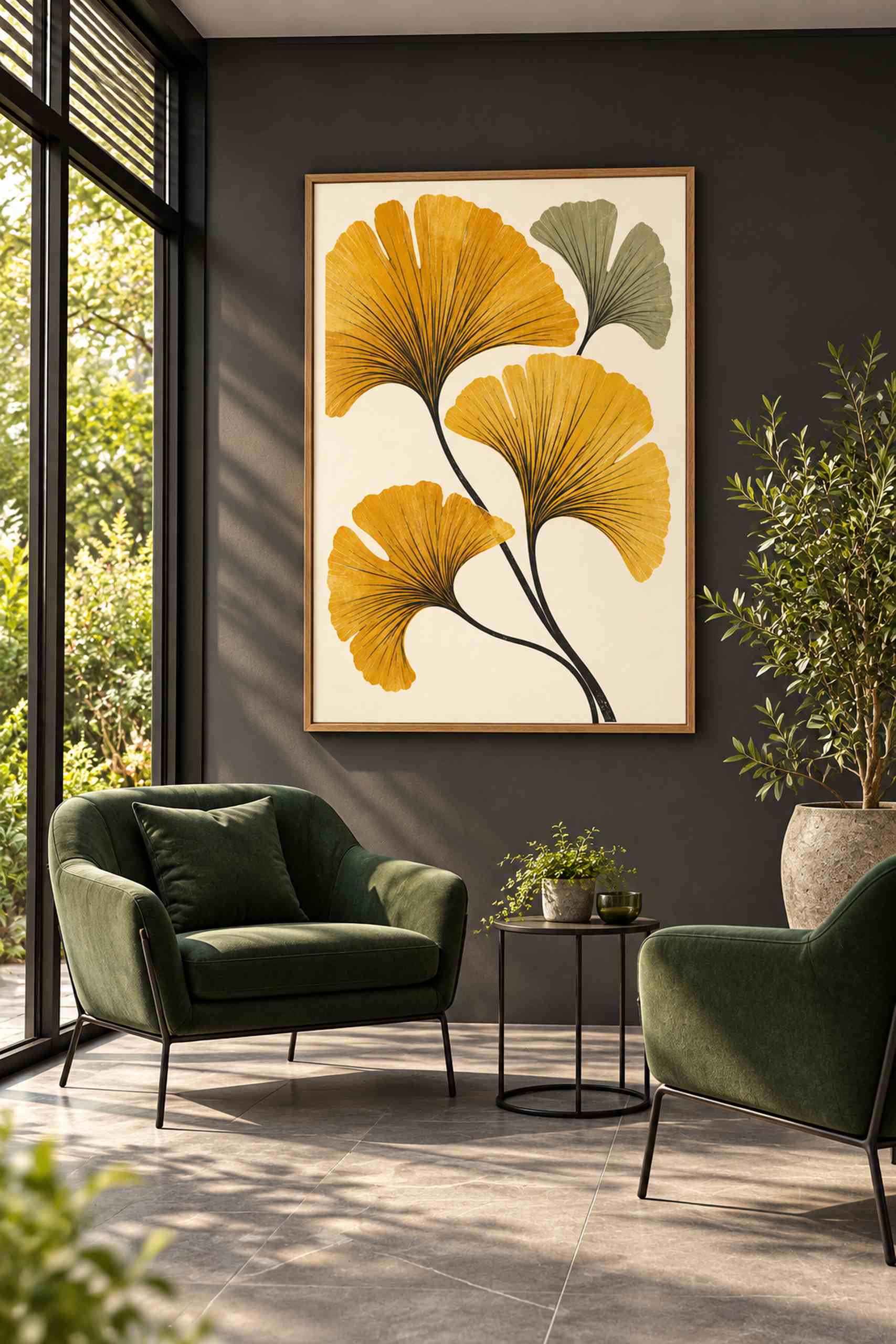
The warm wood frame is one limited material contrast within the darker scheme. Black would connect it more firmly to the window structure but give the print a sharper outline, while a pale frame could make the paper field feel broader. I like the wood here because it lets the picture have one warm edge without asking every chair or table to repeat it. The green seating has a looser connection to the olive leaf, and the gold remains mainly inside the artwork. A room can hold those relationships without being reduced to a palette copied directly from the picture.
The view through the glass is the other substantial visual element. It changes with light, weather and the position from which the room is seen, whereas the poster’s large fans remain stable. That difference is worth protecting. I would avoid crowding the solid wall with additional small frames or placing tall plants directly in front of the print. The garden already supplies plenty of smaller irregular shapes. The poster can offer a simpler rhythm, with enough visible pale field around its stems to remain legible from a chair across the room.
A fully enclosed space should still be assessed as the room it actually is, rather than assumed to behave like any other interior. Check the intended wall, direct sunlight, reflections from the glazing and the conditions specified for the physical paper and frame. The AI-generated scene does not test exposure or establish material durability. A physical sample and a paper template of the full outside frame size will be useful from the main seats and from the approach to the room. A frame that looks clear from one position may catch a window reflection from another, particularly in a space with several glass surfaces.
Paper Garden 04 is printmaking-inspired in appearance, not a claim about a physical linocut process. Its final printed color, texture and glazing need their own choices; the screen preview cannot settle them. What the garden-room concept adds is a distinct application for the same work: pale paper against charcoal, golden fans beside green seating, and strong graphic lines in a room full of finer outdoor detail. I would leave the table large enough for a cup and keep the route around the chairs ordinary. The view can be complicated. The wall does not need to be.