Wild Assembly Gives a Family Reading Nook a Bold Toucan Collage
The beak gets there first. Wild Assembly 01 builds its toucan around an oversized orange-and-yellow shape, with a dark body, a bright eye ring and layers of colored leaves holding the rest of the composition together. It is playful, certainly, but it does not need to live in a nursery. In a family reading corner, a strong animal collage can sit comfortably beside serious books, a good lamp and a chair chosen for staying in. Adults are allowed a bird with a slightly unreasonable beak too.
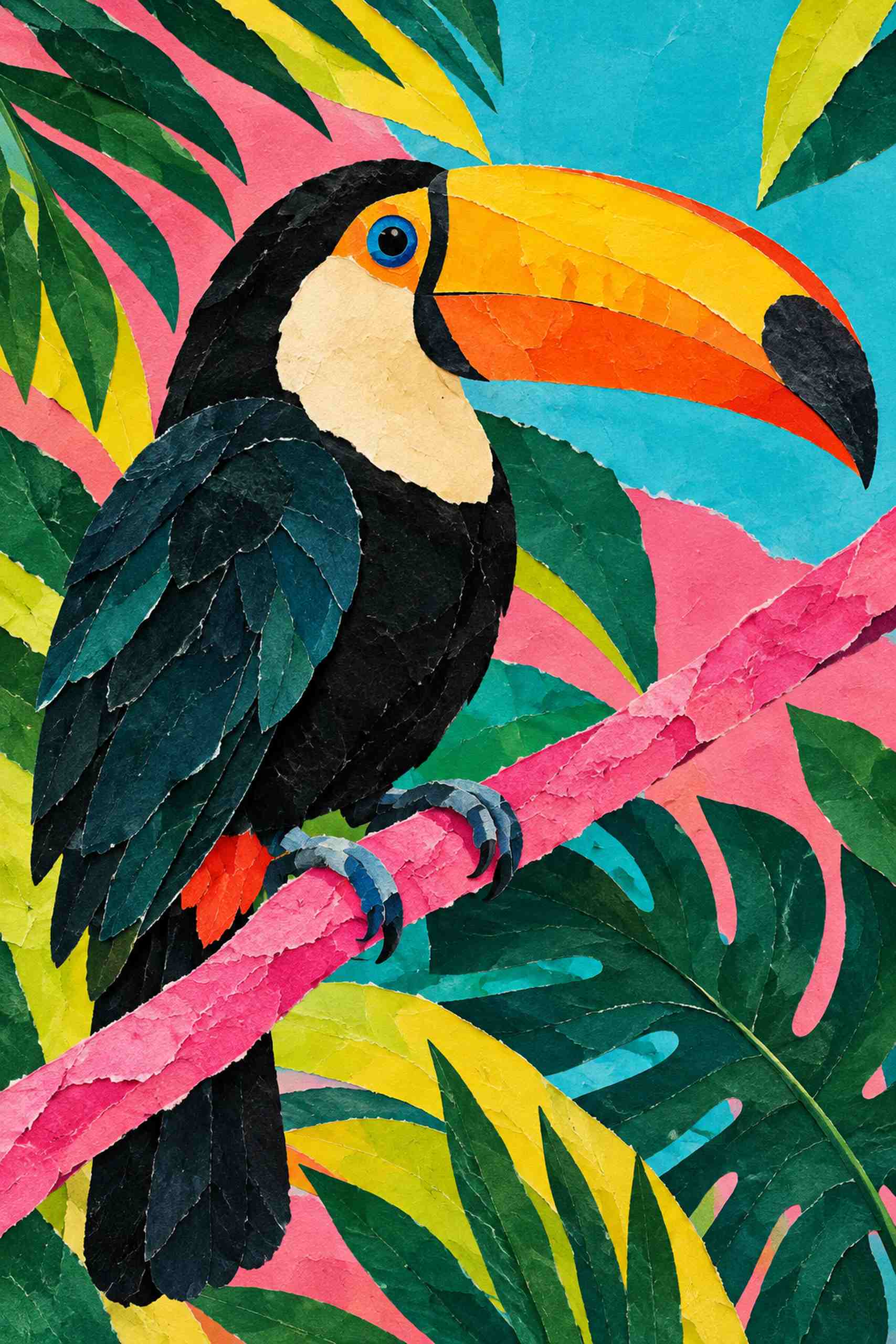
The flat preview shows the material idea clearly. The bird, branch and leaves appear assembled from separate pieces, with uneven fibers and overlapping edges. Dark teal and black give the body enough weight to support the brighter beak, while pink and turquoise prevent the foliage from becoming an uninterrupted green mass. The eye is a small concentrated detail within those larger areas. The poster is an original illustrative collage, not a field-guide plate or a claim about the proportions of a particular bird specimen. Its personality comes partly from exaggeration. Tidying every edge into perfect geometry would make it a less interesting creature.
In our room concept, the bird hangs above a low bookcase beside a deep green reading chair. A coral side table and a small lamp provide useful color rather than a collection of purely decorative objects. The wood floor and pale wall keep the setting light. The frame is narrow enough to leave the collage’s edges in charge of the picture. There is space to reach the books and sit down, and the arrangement does not depend on a floor full of toys to announce that more than one generation might use it. The visual play comes from the artwork itself.
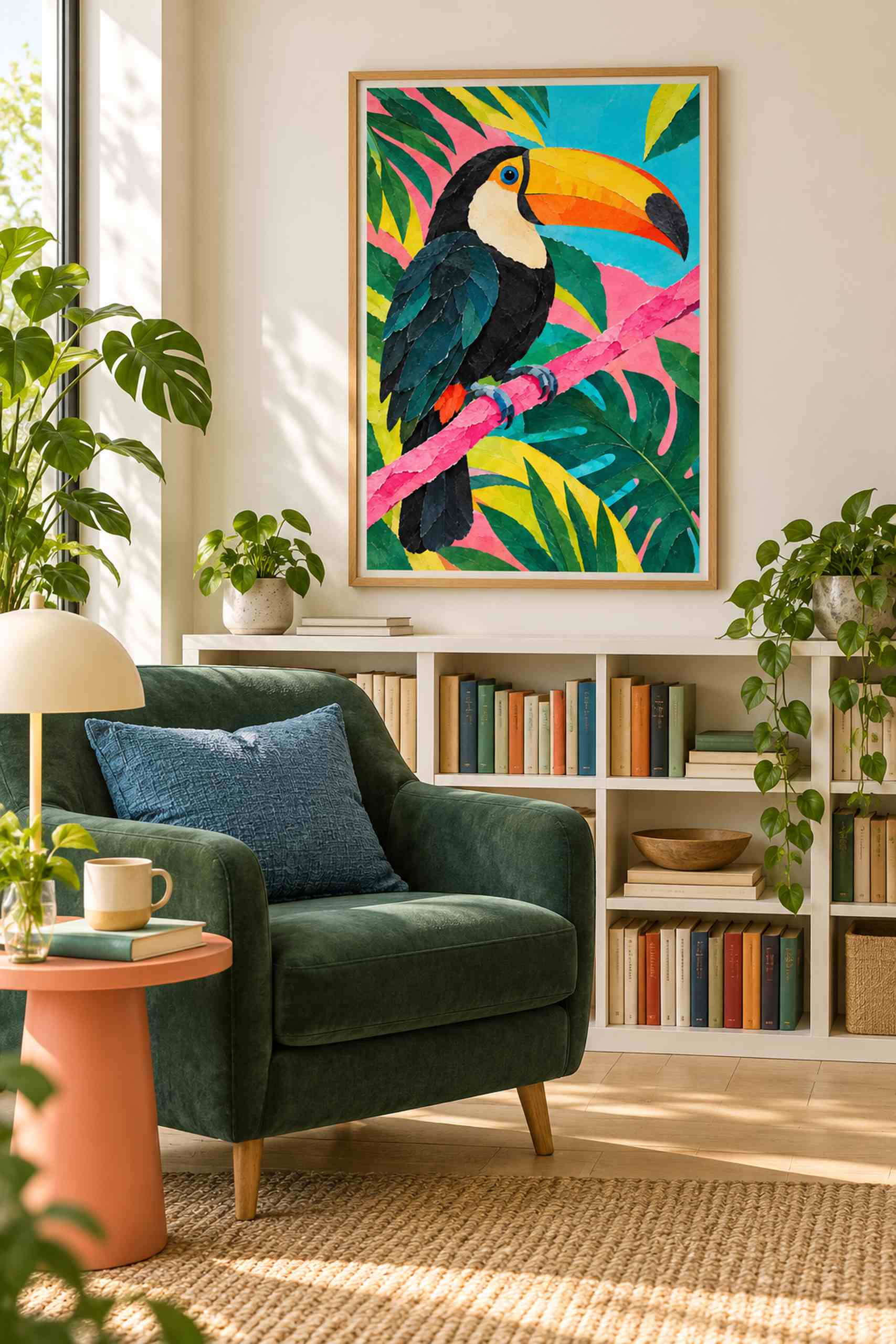
That balance is worth preserving in a real room. If the chair is already brightly patterned, the toucan may work better against a plain stretch of wall with fewer colored objects immediately below. If the furniture is quiet, the poster can establish the strongest palette in the corner. I would choose one existing hue to connect, perhaps the green of the chair, and leave the others inside the image at first. A room does not become more coherent every time another object matches a leaf. Sometimes it simply becomes more occupied.
Wild Assembly begins a new collection around animal forms and layered collage. Its relationship to Paper Garden’s first botanical design is easy to see in the strong shapes and leaf color, but its character is more figurative and mischievous. The collage also invites a different kind of close looking: where does one piece end, what sits over another, and how little detail can still make an eye readable? Those questions are part of enjoying the image. There is no need to attach an educational performance claim to them or suggest that a poster will improve anyone’s reading.
Try the intended frame size with a paper rectangle before hanging it above the bookcase. An image area of 40 by 60 centimeters is one useful starting point; include the frame’s real external measurements and compare a smaller version if the shelving is compact. These are worked examples rather than measurements extracted from the generated room. Check the image from the chair as well as from a standing position. It may be more pleasant to look slightly across to the bird than to crane upward at a picture directly behind your head. Leave normal access to the shelf, lamp and any nearby door clear.
The room view is an AI-generated illustration, while the flat preview is the reference for the artwork. Printed color and the impression of paper texture will depend on the actual edition, paper and lighting, so a web image is not a print proof. I would begin with the simple wood frame shown in the concept and resist the temptation to build a tropical theme around it. The toucan can bring the jungle-shaped energy. The rest of the corner has more ordinary responsibilities: hold the books, support the lamp and provide somewhere comfortable to read the next chapter.